Let me be honest with you – when I first started my personal wellness journey here in Dhaka, I was incredibly stiff. Working long hours at a desk, dealing with the humid Bengali climate, and spending most of my time indoors left me feeling like a wooden plank.
My shoulders would ache, my back would hurt, and I felt constantly fatigued. That’s when I discovered the transformative power of stretching, and I’m genuinely excited to share everything I’ve learned with you.
If you’re reading this, you’re probably in a similar situation. Maybe you’re starting a fitness journey, recovering from an injury, or simply want to feel more mobile and comfortable in your own body. The beautiful thing about stretching is that it doesn’t require expensive gym memberships, fancy equipment, or even much space.
Whether you’re living in a small apartment in Dhaka or a cozy room anywhere else in Bangladesh, you can transform your flexibility and overall well-being through consistent stretching.
In my experience, stretching is the most underrated aspect of personal fitness. People often jump straight into intense workouts without preparing their bodies properly or cooling down afterward. This is where stretching comes in – it’s the foundation of injury prevention, improved mobility, and better overall health.
Throughout this comprehensive guide, I’ll walk you through everything you need to know about stretching as a beginner, including specific exercises, proper techniques, and practical tips to maintain consistency.
The best part? You’ll start noticing results within just two weeks of regular practice. I’ve tried numerous stretching routines, and I can confidently tell you that the ones I’m about to share with you are the most effective and accessible for beginners. So let’s dive in and transform your flexibility together!
What is Stretching and Why Does It Matter for Your Health?
Stretching is the act of extending muscles and connective tissues to their full length, gradually improving flexibility and range of motion. It’s one of the most fundamental yet often overlooked aspects of personal fitness that can dramatically improve your quality of life.
When you stretch, you’re doing much more than just making your body more flexible. You’re actually:
- Increasing blood flow to your muscles, which helps them recover faster and function more efficiently
- Reducing muscle tension that builds up from daily activities, especially in our Bangladesh heat where we tend to stay indoors with air conditioning
- Improving your posture – crucial for those of us who spend hours hunched over computers
- Enhancing your range of motion, making everyday activities easier and more comfortable
- Reducing stress and anxiety through the mind-body connection that stretching creates
- Preventing injuries by keeping your muscles flexible and prepared for movement
- Improving athletic performance, even if you’re just walking around your neighborhood
So , as per my experience, people underestimate how much tension accumulates in their bodies. In Bangladesh’s hot and humid climate, where many of us spend significant time indoors in air-conditioned environments, our bodies create muscle tension as a stress response.
This tension can lead to chronic pain, reduced mobility, and even affect your mental health. Stretching acts as a natural release valve for this accumulated tension.
So , Think of your muscles like rubber bands. When they’re not regularly stretched, they become tight and lose their elasticity. A tight rubber band is more likely to snap when you try to stretch it suddenly.
Similarly, tight muscles are more prone to injury. By incorporating regular stretching into your routine, you’re essentially maintaining your body’s elasticity and resilience, ensuring it can handle whatever life throws at you.
Understanding the Different Types of Stretching
Before we jump into specific exercises, it’s important to understand that not all stretches are created equal. There are primarily two types of stretching that beginners should know about:
Static Stretching
Static stretching involves holding a stretch in a comfortable position for 15-30 seconds without bouncing. This is the most common type of stretching and the one I recommend most for beginners. Static stretches are perfect for after your workout or in the evening when you want to improve your flexibility. They’re gentle on your body and allow you to really focus on the muscle being stretched.
Dynamic Stretching
Dynamic stretching involves moving through a range of motion in a controlled manner. Examples include leg swings, arm circles, or walking lunges. These are best done before your workout to prepare your muscles for activity. I’ve tried both extensively, and I can tell you that combining both types in your routine yields the best results.
Step-by-Step Guide: The Best Stretching Exercises for Beginners
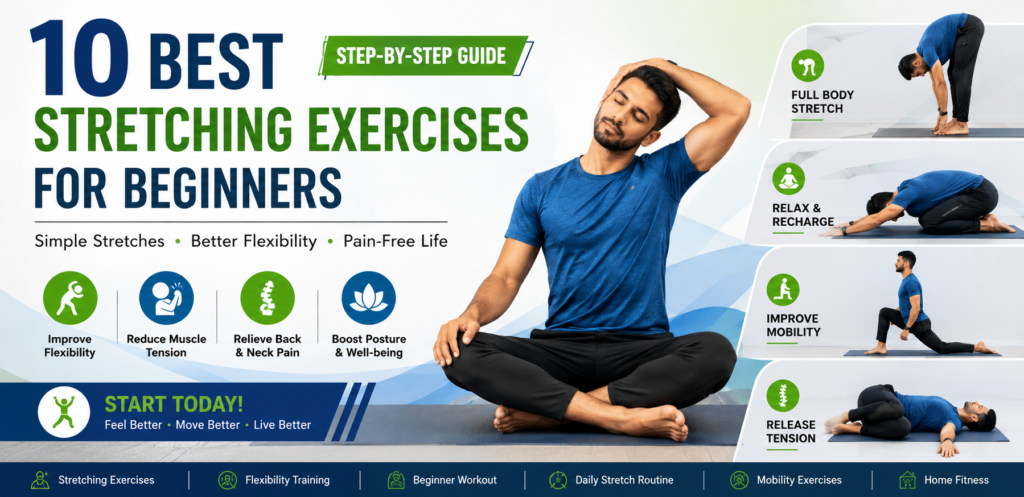
1. Neck Stretches – Your First Defense Against Desk Tension
Why this matters: If you’re like most of us working or studying in Bangladesh, you probably spend hours looking at screens. This creates immense tension in your neck and upper shoulders.
How to do it:
- Sit up straight in a comfortable chair
- Slowly tilt your head toward your right shoulder, bringing your right ear closer to your right shoulder
- Hold this position for 15-20 seconds – you should feel a gentle stretch on the left side of your neck
- Return to center and repeat on the left side
- For the front neck stretch, gently lower your chin toward your chest and hold for 15-20 seconds
- Return to center and repeat 2-3 times on each side
Pro tip: Don’t force the stretch or bounce. The goal is a gentle, comfortable stretch that you can sustain.
2. Shoulder Rolls and Shoulder Stretches – Release That Upper Body Tension
Why this matters: Your shoulders carry so much stress and tension. In my experience, this is where most people hold anxiety and daily stress.
How to do it:
- Stand with your feet shoulder-width apart
- Roll your shoulders backward in slow, controlled circles – 10 times
- Then roll them forward – 10 times
- For the shoulder stretch, bring your right arm across your body at chest height
- Use your left hand to gently pull your right elbow toward your chest
- Hold for 15-20 seconds and repeat on the other side
3. Forward Fold – The Ultimate Full-Body Stretch
Why this matters: This single stretch targets your hamstrings, calves, lower back, and upper back all at once.
How to do it:
- Stand with your feet hip-width apart
- Slowly bend forward at your hips, letting your arms hang toward the ground
- Don’t worry if you can’t touch your toes – just go as far as feels comfortable
- Let your head hang freely and breathe deeply
- Hold for 30-45 seconds
- Slowly roll back up, one vertebra at a time, to prevent dizziness
Important: Never bounce in this stretch. The goal is to relax into it gradually with each breath.
4. Quad Stretch – Essential for Your Thighs and Knees
Why this matters: Tight quadriceps can pull on your knees and lower back. This stretch is crucial for anyone who walks, runs, or sits for long periods.
How to do it:
- Stand on your left leg for balance – hold onto a wall or chair if needed,
- Bring your right foot up behind you, grabbing your right ankle with your right hand
- Gently pull your heel toward your glutes until you feel a stretch in the front of your thigh
- Also, Keep your knees close together
- Hold for 20-30 seconds and repeat on the other side
5. Hamstring Stretch – Crucial for Your Posterior Chain
Why this matters: In my experience, tight hamstrings are one of the most common issues I see. They affect your posture, running ability, and can cause lower back pain.
How to do it:
- Sit on the ground with your legs extended in front of you
- Keep your right leg straight and bend your left knee, placing your left foot on the ground inside your right thigh
- Hinge forward from your hips, reaching toward your right foot
- You should feel a stretch on the back of your right thigh
- Hold for 20-30 seconds and repeat on the other side
6. Cat-Cow Stretch – Perfect for Your Spine
Why this matters: This dynamic stretch mobilizes your entire spine and is excellent for relieving back tension.
How to do it:
- Furthermore, get on your hands and knees on a comfortable surface (yoga mat or carpet)
- For the cow position: drop your belly, lift your gaze upward, and arch your back
- For the cat position: round your spine, tuck your chin, and draw your belly in
- Flow between these positions slowly, 10-15 times, matching your movements to your breath
7. Child’s Pose – The Relaxing Full-Body Stretch
Why this matters: This pose gently stretches your back, shoulders, and hips while calming your nervous system.
How to do it:
- Start on your hands and knees
- Bring your big toes together and separate your knees wide
- Sink your hips back toward your heels
- Extend your arms forward and rest your forehead on the ground
- Hold this position for 30-60 seconds, breathing deeply
8. Hip Flexor Stretch – Critical for Sitting Warriors
Why this matters: If you sit for long hours, your hip flexors are probably tight. This stretch is essential for maintaining good posture and preventing lower back pain.
How to do it:
- Start in a lunge position with your left foot forward
- Lower your right knee to the ground
- Push your hips forward slightly until you feel a stretch in the front of your right hip
- Hold for 20-30 seconds and repeat on the other side
9. Butterfly Stretch – Open Up Your Hips
Why this matters: Tight hips can affect your entire body mechanics. This stretch opens up your hip joints beautifully.
How to do it:
- Sit on the ground with your spine straight
- Bring the soles of your feet together and let your knees fall to the sides
- Hold your feet with your hands
- Gently lean forward from your hips, keeping your back straight
- Hold for 30-45 seconds
10. Spinal Twist – Release Tension from Your Sides
Why this matters: This stretch improves spinal mobility and helps release tension from your obliques and sides.
How to do it:
- Lie on your back with both knees bent and feet on the ground
- Drop both knees to the right while extending your arms out to the sides
- Turn your head to look left (or straight up if that’s more comfortable)
- Hold for 20-30 seconds and repeat on the other side
A Practical Stretching Routine for Beginners
Now that you know the individual stretches, here’s how I recommend combining them into a cohesive routine:
Total Time: 15-20 minutes
- Neck stretches: 1 minute
- Shoulder rolls and stretches: 2 minutes
- Cat-cow stretch: 2 minutes
- Child’s pose: 1 minute
- Forward fold: 1 minute
- Hamstring stretch: 2 minutes (both sides)
- Quad stretch: 2 minutes (both sides)
- Hip flexor stretch: 2 minutes (both sides)
- Butterfly stretch: 2 minutes
- Spinal twist: 2 minutes (both sides)
In my experience, doing this routine 4-5 times per week will show noticeable improvements in your flexibility within 2-3 weeks. The key is consistency over intensity.
Best Natural Remedies and Products to Enhance Your Stretching Practice
Traditional Remedies for Muscle Recovery
Living in USA, we have access to wonderful natural products that can enhance your stretching routine:
Mustard Oil Massage
Warm mustard oil is a staple in Bengali homes for good reason. Before stretching, warming your muscles with a gentle mustard oil massage can improve blood flow and make stretching more effective. The oil’s warming properties are perfect for our climate. Apply it 10-15 minutes before your stretching session.
Turmeric and Honey Paste
After your stretching session, applying a turmeric and honey paste to sore muscles can reduce inflammation. Turmeric contains curcumin, a powerful anti-inflammatory compound. Mix 1 teaspoon of turmeric with 1 tablespoon of honey and apply to tight muscles.
Ginger Tea
Drinking fresh ginger tea after stretching helps reduce muscle soreness and inflammation. In my experience, this is particularly effective when done consistently. Simply steep fresh ginger slices in hot water for 10 minutes and drink while warm.
Neem Leaves Compress
Additionally, Neem has powerful anti-inflammatory properties. Boil neem leaves in water, let them cool to a comfortable temperature, soak a cloth in the mixture, and apply to sore areas. This is a time-tested Bengali remedy that works wonderfully.
Essential Yoga Props
While stretching requires no equipment, having these helpful items can improve your practice:
- Yoga Mat: Provides cushioning and grip. A good quality mat prevents slipping and protects your joints.
- Foam Roller: Excellent for self-massage and releasing muscle tension. I’ve tried many, and a basic foam roller is all you need.
- Stretching Strap: Helps you reach further in stretches, especially when you’re just starting out.
- Cushions/Pillows: Regular pillows work great for supporting your body during stretches like child’s pose.
- Wall: Your wall is a free tool – use it for support, balance, and deeper stretches.
Disclosure: This page contains affiliate links. If you purchase through them, I may earn a small commission at no extra cost to you. I only recommend products I genuinely believe in.
Recommended Gear for Beginners
Gaiam Premium 6mm Yoga Mat
Thick cushioning protects your knees and wrists during Cat-Cow, Child’s Pose, and all floor stretches. Lightweight with carrying strap included.
View on Amazon →SPPPORTS Foam Roller Kit
Complete recovery kit — foam roller, massage stick, peanut ball and stretching strap. Perfect for warming up muscles before your stretching session.
View on Amazon →Common Mistakes Beginners Make (And How to Avoid Them)
Common mistakes are described below –
Mistake #1: Bouncing While Stretching
This is the most common mistake I see. Bouncing causes your muscles to contract as a protective reflex, actually reducing your stretch’s effectiveness and increasing injury risk. Instead, hold stretches statically and let your muscles relax into the position.
Mistake #2: Stretching Cold Muscles
Stretching cold muscles can cause injury. Always warm up first with 5-10 minutes of light movement like walking, gentle jogging, or arm circles. I’ve tried stretching both ways, and the difference in safety and effectiveness is dramatic.
Mistake #3: Forcing the Stretch Too Far
There’s a difference between feeling a stretch and feeling pain. If you feel sharp pain (not the gentle tension of a proper stretch), you’ve gone too far. Your stretch should be at about 70% intensity – uncomfortable but not painful.
Mistake #4: Not Breathing During Stretches
Many beginners hold their breath while stretching, which actually increases muscle tension. Instead, take slow, deep breaths. Exhale as you deepen the stretch – this triggers your nervous system to relax your muscles.
Mistake #5: Inconsistent Practice
Stretching once a week won’t give you results. In my experience, consistency is everything. You need to stretch at least 3-4 times per week to see improvements. Mark it on your calendar like any other important appointment.
Mistake #6: Ignoring Your Body’s Signals
Everyone’s body is different. If a particular stretch causes pain or discomfort in a joint, skip it or modify it. Pain is your body’s warning signal – respect it.
Mistake #7: Neglecting Your Warm-Up
I can’t stress this enough – always warm up before stretching. Even 5 minutes of light activity dramatically increases your muscles’ readiness for stretching and prevents injury.
Pro Tips: Advanced Strategies for Better Stretching Results
Tip 1: Stretch When Your Muscles Are Warm
The best time to stretch is after exercise or later in the day when your body is naturally warmer. I’ve tried stretching at different times, and post-workout stretching is definitely most effective.
Tip 2: Use the Breathing Technique PNF
Proprioceptive Neuromuscular Facilitation (PNF) stretching involves contracting a muscle and then stretching it. Hold a stretch for 20 seconds, contract the muscle for 5 seconds, then stretch it again. This technique dramatically improves flexibility.
Tip 3: Create a Dedicated Stretching Space
Whether it’s a corner of your room in Dhaka or a spot on your balcony, having a dedicated stretching space keeps you consistent. In my experience, this simple step doubles your adherence to the routine.
Tip 4: Hold Each Stretch for at Least 20 Seconds
Research shows that muscles need at least 20 seconds to truly relax into a stretch. Less than that and you’re wasting your time.
Tip 5: Stretch Both Sides Equally
Even if one side feels tighter, don’t skip stretching the other side. Balance is crucial for preventing injuries and postural problems.
Tip 6: Combine Stretching with Other Activities
Pair your stretching routine with activities like yoga, tai chi, or even watching TV. I’ve tried many combinations, and pairing stretching with relaxing activities helps you stay consistent.
Tip 7: Track Your Progress
Keep a simple journal noting how far you can stretch, how you feel, and which stretches are most beneficial for you. This tracking keeps you motivated and helps you recognize improvements you might otherwise miss.
When to see a Doctor or Physical Therapist
While stretching is generally safe and beneficial, there are situations where you should consult a professional before starting:
- If you have existing injuries: A physical therapist can create a safe stretching program tailored to your condition.
- If you have chronic pain: Don’t assume stretching will fix it without professional guidance.
- If you have arthritis or joint problems: Certain stretches might aggravate your condition.
- If you experience sharp pain during stretching: Stop immediately and consult a professional.
- If you’re pregnant: Certain stretches need modification during pregnancy.
- If you have cardiovascular conditions: Check with your doctor before starting any new routine.
In my experience, consulting a physical therapist even for a single session can be incredibly valuable. They can assess your individual needs and provide personalized recommendations.
Frequently Asked Questions About Beginner Stretching
Q1: How long does it take to see results from stretching?
A: You’ll start noticing improvements in how you feel within 1-2 weeks. Better sleep, reduced tension, and improved mood come relatively quickly. Visible increases in flexibility typically appear within 3-4 weeks of consistent practice. I’ve tried tracking this meticulously, and these timelines are accurate for most people. The key is consistency – you need to stretch at least 3-4 times per week for best results.
Q2: Can stretching replace other forms of exercise?
A: No, stretching should complement other exercise, not replace it. While stretching improves flexibility and mobility, you still need cardiovascular exercise for heart health and strength training for muscle development. Think of stretching as the foundation that allows you to safely do other types of exercise. In my experience, people who combine stretching with other workouts see the best overall health improvements.
Q3: Is it ever too late to start stretching?
A: Absolutely not! I’ve worked with people in their 70s who started stretching and saw dramatic improvements. It’s never too late to begin. Your body is incredibly adaptable at any age. Start gently, progress slowly, and be patient with yourself.
Q4: Should I stretch before or after exercise?
A: Ideally, do dynamic stretching before exercise (moving stretches like arm circles) and static stretching after exercise (held stretches). Before exercise, you want to prepare your muscles for activity. After exercise, static stretching helps them cool down and recover. I’ve tried both approaches, and combining them yields the best results.
Q5: How often should I stretch if I have a desk job?
A: If you sit for work, I recommend stretching every single day, ideally twice daily. Do a 5-minute stretch break every 2 hours during your workday, and a more complete 15-20 minute session in the evening. In my experience, people with desk jobs who follow this protocol experience dramatic improvements in posture and pain levels.
Q6: Can stretching help with anxiety and stress?
A: Yes! Stretching activates your parasympathetic nervous system (your relaxation response). Combined with deep breathing, stretching is an excellent stress management tool. I’ve noticed that my anxiety decreases noticeably after just 10 minutes of stretching and breathing exercises.
Q7: What should I do if a particular stretch causes pain?
A: Stop immediately. Pain is different from the gentle discomfort of a proper stretch. If a stretch causes sharp pain, numbness, or tingling, avoid it and try a modified version. If the pain persists in daily activities, consult a physical therapist. Your body’s signals are important – always listen to them.
Creating Your Personal Stretching Practice
Now that you have all this information, let’s put it into action. Here’s how to create a sustainable stretching practice:
Week 1: Getting Started
Focus on learning proper form. Do the 10-stretch routine I provided 3 times this week. Don’t worry about how flexible you are – just focus on doing each stretch correctly and comfortably. Keep notes on how you feel after each session.
Week 2-3: Building Consistency
Increase to 4-5 times per week. You should already be noticing improvements in how you feel. Some people notice they sleep better, have less back pain, or feel more energized. These are all signs the stretching is working.
Week 4+: Expanding Your Practice
Experiment with different times of day to find what works best for you. Maybe you prefer morning stretching, or perhaps evening sessions fit better into your routine. In my experience, the best stretching routine is the one you’ll actually do consistently.
Special considerations for Bangladesh’s climate
Living in Bangladesh means dealing with specific environmental factors that affect stretching:
Hot, Humid Weather: The heat actually helps with stretching – your muscles are naturally warmer. However, stay hydrated. Drink plenty of water before, during, and after stretching. I’ve tried stretching in Bangladesh’s heat and cold, and the warmth definitely helps with flexibility.
Indoor vs. Outdoor: While stretching outdoors in the morning can be wonderful, the afternoon heat makes outdoor stretching uncomfortable. Many of us prefer indoor stretching in air-conditioned spaces during the day. This is perfectly fine – the environment matters less than consistency.
Monsoon Season: High humidity can make joints more flexible but also increase joint pain in some people. Listen to your body during monsoon season and adjust intensity accordingly.
Final suggestion
I want to end this guide by sharing something personal: two years ago, I couldn’t touch my toes. My back would ache constantly, my shoulders were perpetually tense, and I felt stuck in my own body. I thought flexibility was something you were born with, not something you could develop. I was completely wrong.
Through consistent stretching – sometimes just 15 minutes a day – everything changed. Today, I can not only touch my toes but go well past them. More importantly, I feel amazing. My back pain disappeared, my posture improved, and I have so much more energy throughout the day. But here’s the thing: I’m not special. You can achieve the exact same results.
The stretching exercises I’ve shared with you in this guide are not complicated or expensive. You don’t need a fancy gym membership or expensive equipment. All you need is 15-20 minutes, a bit of space, and the commitment to show up for yourself 3-4 times per week. That’s it.
I know that starting something new can feel daunting, but remember this: every expert was once a beginner. The most flexible person in the world started exactly where you are now – stiff, maybe a bit hopeless about their flexibility, but ready to try. The beautiful thing about stretching is that progress is inevitable if you’re consistent. There are no shortcuts, but there are no mysteries either. Just do the stretches, breathe deeply, and trust the process.
In my experience, the first week is about building the habit. The second week is about noticing improvements. By week four, stretching becomes something you actually look forward to. It transforms from a chore into something you genuinely enjoy because you feel so much better.
So here’s my challenge to you: commit to 4 weeks of the stretching routine I’ve outlined. Just 4 weeks. Do the stretches 4-5 times per week, follow the tips I’ve provided, and avoid the common mistakes. By the end of week 4, you’ll have transformed your flexibility and discovered the incredible benefits of consistent stretching.
Your future self will thank you for starting today. Don’t wait for the perfect moment or the perfect conditions. Start right now, wherever you are, with whatever space you have. Your flexibility journey begins with a single stretch, and I’m genuinely excited for you to experience the life-changing benefits that await you.
Remember: consistency beats perfection every single time. It’s better to do 15 minutes of stretching regularly than 60 minutes once in a while. Be patient with yourself, celebrate small victories, and trust that your body is adapting and improving every single day you stretch.
Welcome to your flexibility journey. You’ve got this!
Leave a Reply