Let me take you back to a Tuesday morning in my mid-twenties. I’m standing in front of the bathroom mirror, 7:15 AM, about to leave for work. And there it is — a brand new breakout sitting right on my jawline, angry and red and completely uninterested in my timeline.
I’d tried doing nothing and just “letting my skin breathe.” Nothing worked. My skin was oily by noon, broken out half the month, and dull the rest of the time, and I genuinely didn’t understand why.
I’m writing this post because I eventually figured it out — but not before wasting probably two years and a ridiculous amount of money on products that either did nothing or made things worse.
This isn’t a list of miracle ingredients and before/after promises. It’s everything I actually learned, including the embarrassing mistakes, the habit changes that felt small but made a huge difference, the simple DIY treatments that worked, and the products I still use today.
Whether you’re dealing with oily skin, teen acne, dullness, uneven tone, or you just want that genuine glass-skin glow you keep seeing on your feed — this guide is for you.
And I’m going to be honest throughout, which means I’ll tell you when something takes time and when something is genuinely not worth your money.
First, Let’s Talk About Why Your Skin Isn’t Clear Right Now
Before you can fix something, you have to understand what’s breaking it. Clear skin isn’t about having a perfect genetics lottery win — it’s about understanding what’s disrupting your skin’s natural balance and removing those disruptions one by one.
Your skin barrier is probably damaged
This was the piece I was missing for years. Your skin has a barrier — a thin, protective layer made up of lipids, ceramides, and skin cells — that keeps moisture in and irritants out.
When that barrier is damaged, your skin gets oily (your sebaceous glands overproduce oil to compensate for moisture loss), breaks out more easily, looks dull, and reacts to products that shouldn’t cause reactions.
How do you damage your skin barrier? By using alcohol-based toners. Changing products constantly so your skin never gets a chance to stabilize. Sound familiar? Every single one of those was me.
You’re using too many products, not too few
I had a six-step routine at one point. Cleanser, toner, exfoliating toner, vitamin C serum, moisturizer, SPF in the morning. Retinol, second cleanser, treatment serum, eye cream, night moisturizer at night. My skin hated me, and I couldn’t figure out why because everything I was using was a “good” product.
Here’s what nobody tells you: combining too many active ingredients — especially acids, vitamin C, retinol, and benzoyl peroxide all in the same routine — creates a cocktail that strips and irritates your barrier faster than any single ingredient would alone.
Less is genuinely more, especially when you’re trying to reset problem skin.
Your lifestyle is doing more damage than your skincare can fix
I’ll get into this more later, but your skin is a direct reflection of what’s happening inside your body and your daily habits. Chronic stress breaks down collagen and triggers oil production. Poor sleep increases inflammation.
A diet heavy in refined sugar causes glycation — basically, sugar molecules attaching to collagen and making it stiff and dull. Touching your face constantly transfers bacteria. Sleeping on a pillowcase you haven’t washed in two weeks is doing things I’d rather not think about.
The best skincare routine in the world cannot fully compensate for a lifestyle that’s working against your skin. This is the part people skip because it’s not as fun as buying a new serum. But it’s the part that matters most.
How to Get Clear Skin fast: The Step-by-Step Breakdown
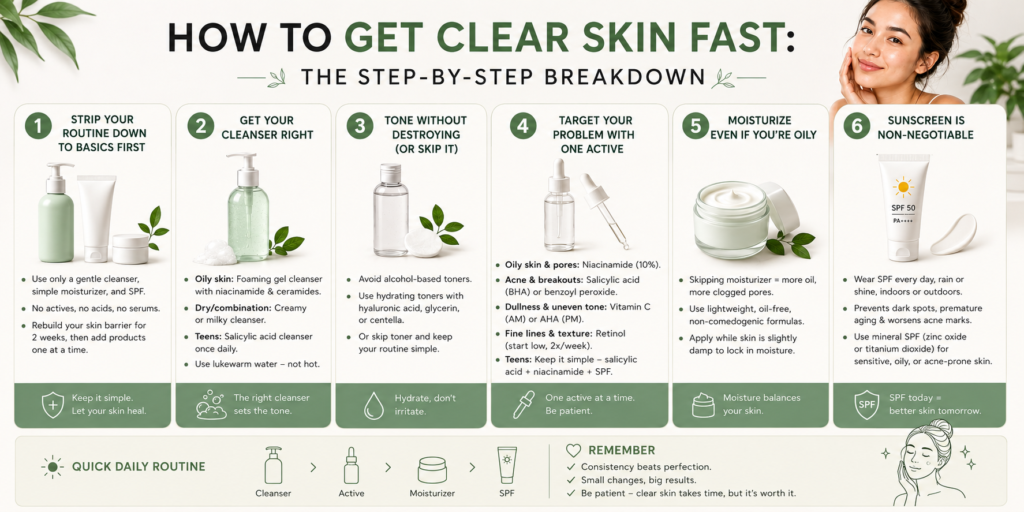
Step 1: Strip Your Routine Down to Basics First
Before you add anything new, take everything out. For two weeks, use only three things: a gentle cleanser, a simple moisturizer, and SPF in the morning. That’s it. No actives, no acids, no serums.
This sounds boring. It is boring. It’s also often the fastest way to see your skin improve, because you’re giving your damaged barrier time to repair itself without being constantly bombarded.
I did this after my worst breakout period — the one that finally pushed me to actually research what I was doing — and within ten days, my skin was less red, less reactive, and my oiliness had genuinely reduced. Not because I’d found a magic product. Because I’d stopped attacking my own skin.
After two weeks of the basics routine, you introduce one new product at a time, with a full two-week wait between each addition. Yes, this is slow. Yes, it’s worth it.
When you add products slowly, you actually know what’s working and what’s causing problems, instead of guessing which of the eight things you started simultaneously is making you break out.
Step 2: Get Your Cleanser Right
This is the most underrated step in any skincare routine. The wrong cleanser can single-handedly destroy everything else you’re doing, because it’s the first thing that touches your skin and sets the tone for everything that comes after.
For oily and acne-prone skin: You want a foaming gel cleanser that removes excess oil without stripping. Look for niacinamide and ceramides in the formula — you want to clean without dismantling your barrier. Do not use anything marketed as “deep cleaning” or “pore purifying” with a long list of sulfates. That tight, squeaky-clean feeling after washing? That’s your barrier screaming.
For dry or combination skin: A creamy or milky cleanser that cleanses without foaming aggressively is your friend. You need something that cleans the surface without pulling moisture out of skin that’s already struggling to retain it.
For teens dealing with acne: Salicylic acid in your cleanser is genuinely useful — it’s a beta hydroxy acid that gets into pores and dissolves the sebum and dead skin cells that cause blackheads and breakouts. But use it once a day maximum, not morning and night.
One thing I changed that made a difference I didn’t expect: water temperature. Hot water feels good but expands pores and strips oils. Lukewarm — not cold, not hot — is the right temperature for washing your face.
Step 3: Tone Without Destroying (Or Skip It Entirely)
Traditional toners with alcohol in them are essentially purpose-built barrier destroyers. They were formulated in an era when people believed oily skin needed to be “de-greased” as aggressively as possible. We know better now.
If you want to use a toner, use a hydrating one — essentially a watery, lightweight moisturizing layer that preps your skin for serums. Look for hyaluronic acid, glycerin, or centella asiatica. Apply it while your skin is still slightly damp from cleansing.
Honestly? If you’re keeping your routine simple while rebuilding your barrier, skip toner entirely. It’s the most optional step.
Step 4: Target Your Specific Problem with One Active Ingredient
Once your barrier is stable — skin is less reactive, less flaky, not stinging when you apply products — you can introduce one targeted active ingredient. Just one, at least to start.
For oily skin and large pores: Niacinamide (vitamin B3) is the ingredient. It regulates sebum production, minimizes the appearance of pores, reduces redness, and evens skin tone. At 10% concentration it works in visible ways within a few weeks. This was the single biggest game-changer for my oily, acne-prone skin.
For active breakouts and acne: Salicylic acid (BHA) goes into pores and clears them out. Benzoyl peroxide kills acne-causing bacteria. Niacinamide reduces post-acne redness. You don’t need all three simultaneously — pick the one that addresses your type of acne. Blackheads and congestion: salicylic acid. Red, inflamed pimples: benzoyl peroxide.
For dullness and uneven tone: Vitamin C in the morning is unbeatable for brightening and antioxidant protection. Glycolic or lactic acid (AHAs) used a few nights a week speed up cell turnover and reveal fresher skin underneath.
For fine lines and texture: Retinol at night is the gold standard, but start at the lowest available concentration (0.025% or 0.05%) and only use it twice a week for the first month.
Retinol gets a bad reputation for causing peeling and redness — but that usually happens because people start at too high a concentration or use it every night immediately.
For teens specifically: Keep it gentle. Salicylic acid cleanser, niacinamide serum, SPF. That’s a complete, effective teen routine. You don’t need retinol at 16. You don’t need vitamin C serums. Keep it simple and consistent.
Step 5: Moisturize Even If You’re Oily
I avoided moisturizer for two years because I thought my oily skin didn’t need it. This was one of the most expensive mistakes I made — not in money, but in skin health.
Skipping moisturizer when you have oily skin is counterproductive: your sebaceous glands produce more oil to compensate for the moisture your skin isn’t getting. More oil = more shine = more clogged pores.
The trick is choosing the right moisturizer. For oily skin, you want something labeled “oil-free,” “non-comedogenic,” and with a lightweight gel or lotion texture. Avoid anything with heavy occlusives like petrolatum or shea butter as the primary ingredients if you’re acne-prone.
For dry or normal skin, a creamier formula with ceramides and squalane gives your barrier the building blocks it needs.
Apply moisturizer while your skin is still slightly damp — within 60 seconds of washing or applying toner — to lock in the residual moisture.
Step 6: Sunscreen Is Non-Negotiable (I Cannot Stress This Enough)
If there is one single product that will do more for your skin long-term than anything else on this list, it’s daily SPF. Not just on beach days. Every day. Rain or shine, indoors or outdoors.
UV exposure is the number one external cause of premature aging, hyperpigmentation, and dark spots. It also worsens post-acne marks — those brown spots left behind after a pimple heals — and slows the healing process of active breakouts.
Every time you skip SPF, you’re undoing a measurable amount of the work everything else is doing.
For oily or acne-prone skin, mineral SPF (zinc oxide or titanium dioxide) is typically better tolerated than chemical UV filters. It sits on top of the skin rather than absorbing into it, which means less chance of clogging pores or causing breakouts. The newer mineral formulas don’t leave that white cast that older generations had — technology has caught up.
How to Get Clear Skin fast Naturally at Home: The Habits That Actually Work
Products matter, but habits matter more. Here are the ones I changed that made a real, visible difference:
Wash your pillowcase twice a week. I know this sounds excessive. Your pillowcase absorbs oil, sweat, bacteria, and dead skin cells every single night, and then you press your face against it for 7–8 hours.
Switching to a clean case every two to three days — or using a silk pillowcase, which is less absorbent and gentler on skin — made a noticeable difference for me within two weeks.
Stop touching your face. This is harder than it sounds, especially if you’re a habitual chin-rester or cheek-toucher. Your hands carry bacteria that causes exactly the kind of inflammation that turns into acne. I started keeping my hands busier — fidget-type habits — and my cheeks cleared up in a way I genuinely hadn’t expected.
Drink water like it’s your job. I know this sounds like basic advice, but chronic mild dehydration shows up in your skin as dullness, exaggerated fine lines, and a flat lack of glow. Eight glasses a day is a rough target; more if you’re active. Within a week of consistently hydrating properly, my skin literally looked plumper.
Cut back on refined sugar and dairy. Both have documented links to acne for a significant portion of people — dairy because it contains growth hormones that can trigger sebum production, refined sugar because it spikes insulin and causes inflammation.
I’m not saying go dairy-free forever, but if you’re trying to clear up persistent breakouts, cutting these back for four to six weeks and observing your skin is genuinely worth doing. My jawline acne — the hormonal-looking kind — got dramatically better when I reduced my dairy intake.
Manage stress, because your skin literally responds to cortisol. Easier said than done, I know. But cortisol — your stress hormone — directly triggers oil production, breaks down collagen, and impairs your skin’s barrier function. Exercise helps. Sleep helps. Whatever reduces your stress load meaningfully — find it and protect it.
Change your face towel every 2–3 days. Or better yet, switch to disposable cotton pads or single-use facial cloths for drying. Regular bath towels harbor bacteria and can scratch skin more than you realize.
A Simple DIY Routine for Clear Skin at Home
If you don’t want to invest in products just yet, here’s what works from your kitchen and medicine cabinet:
DIY gentle exfoliant: Mix plain yogurt (lactic acid) with a teaspoon of honey (antimicrobial, humectant). Apply for 10 minutes, rinse off. The lactic acid gently exfoliates and the honey soothes. Do this once a week, not more.
Ice for active breakouts: A cube of ice wrapped in a clean cloth and held against a fresh pimple for 1–2 minutes reduces inflammation and redness without drying out the skin around it.
Green tea as a toner: Brew green tea, let it cool completely, apply with a cotton pad. It’s rich in antioxidants and has mild anti-inflammatory properties. Won’t replace an actual skincare routine, but it’s a genuinely soothing, zero-irritation option.
Aloe vera for redness and healing: Straight aloe vera gel (from the plant or a pure, additive-free product) is one of the most universally tolerated soothing ingredients available. Apply a thin layer after cleansing when your skin is angry or irritated.
What doesn’t work from the kitchen: lemon juice directly on skin (too acidic, causes photosensitivity and irritation), toothpaste on pimples (the fluoride and SLS cause contact dermatitis), baking soda scrubs (strips your barrier and disrupts your skin’s pH catastrophically).
5 Amazon Products That Actually Help You Get Clear Skin
Disclosure: This post contains affiliate links. I may earn a small commission if you purchase through these links, at no extra cost to you. I only recommend products I’ve personally used or that are consistently backed by dermatologists.
These aren’t sponsored recommendations. They’re the products I’ve actually used or that come up again and again in dermatologist roundups — chosen because they cover every major step in a clear-skin routine and because they’re affordable enough that trying them doesn’t feel like a financial commitment.
1. CeraVe Foaming Facial Cleanser — Best Everyday Face Wash for Oily Skin
Best for: Normal to oily, acne-prone skin
Key ingredients: Ceramides 1, 3 & 6-II, Hyaluronic Acid, Niacinamide
Price range: ~$14–$18 (16 oz)
This is the cleanser I switched to when I stripped my routine down, and I haven’t used anything else since. The formula transforms from a clear gel into a gentle foam that removes oil, makeup, and debris without that tight, stripped feeling that signals barrier damage.
What makes it stand out for oily and acne-prone skin is the combination of ceramides (to protect and rebuild the barrier) with niacinamide (to calm and regulate oil) in a cleanser format — most cleansers at this price point have neither. It’s fragrance-free, non-comedogenic, and developed with dermatologists. The #1 dermatologist-recommended skincare brand globally for a reason.
I use this every morning and every evening. It consistently shows up as the first or second recommendation whenever dermatologists are asked about the best face wash for acne-prone skin.
2. The Ordinary Niacinamide 10% + Zinc 1% — Best Serum for Oily Skin and Pores
Best for: Oily skin, enlarged pores, acne marks, uneven texture
Key ingredients: 10% Niacinamide (Vitamin B3), 1% Zinc PCA
Price range: ~$8–$12 (1 oz)
The Ordinary changed what affordable skincare looked like, and this serum is probably their most iconic product for good reason. At $10 for a full ounce, it delivers a clinical-grade concentration of niacinamide that you’d pay four times more for in a branded formula.
The 10% niacinamide visibly reduces sebum production, smooths texture, brightens overall skin tone, and fades the red and brown marks left behind by acne. The added zinc PCA specifically targets excess oil regulation and has mild antimicrobial properties — useful for acne-prone skin.
Clinical testing shows pore visibility is reduced within four weeks of consistent use. In practice: I started noticing my skin looked less shiny by the end of the first week, and the hyperpigmentation from old breakouts was noticeably lighter within six weeks.
Apply a few drops to clean skin, morning and evening, before moisturizer. Avoid using it at the same time as vitamin C or acids — not because it’s dangerous, but because the pH ranges of these ingredients conflict and reduce effectiveness. Use niacinamide in the morning and acids or vitamin C at night.
3. Hero Cosmetics Mighty Patch Original — Best Spot Treatment for Active Breakouts
Best for: Treating active whiteheads and surface-level pimples overnight
Key ingredients: Hydrocolloid gel
Price range: ~$13–$15 (36 patches)
Okay, I’ll be honest about why I resisted pimple patches for so long: they seemed gimmicky. A sticker on your face. How is that a skincare product?
Then I had a particularly stubborn breakout before a work presentation and I finally tried one out of desperation. The next morning, the patch had turned white — it had visibly drawn out the sebum and fluid from the pimple — and the spot was flat, less red, and on its way out instead of still ramping up.
Hydrocolloid patches work by creating a moist healing environment that accelerates recovery, while simultaneously absorbing the contents of a pimple and physically preventing you from touching or picking at it. That second part is arguably more valuable than the first — picking at breakouts causes scarring that takes months to fade.
Mighty Patch has a 4.6-star rating from over 170,000 Amazon reviews. One patch before bed, gone in the morning. Use on whiteheads and surface-level active pimples; they don’t work on deep cystic acne (nothing topical really does on those — that’s a dermatologist conversation).
4. The Ordinary Glycolic Acid 7% Toning Solution — Best for Dullness, Texture, and Glow
Best for: Dull, uneven skin tone; rough texture; mild hyperpigmentation
Key ingredients: 7% Glycolic Acid, Aloe Vera, Ginseng, Tasmanian Pepperberry
Price range: ~$10–$14 (8.1 oz)
If clear skin to you means glowing clear skin — smooth texture, even tone, that healthy luminosity — then a glycolic acid toner used a few nights a week is your path there.
Glycolic acid is an AHA (alpha hydroxy acid) that dissolves the bonds holding dead skin cells to the surface of your skin, allowing them to shed more readily and revealing the fresher, brighter skin underneath. At 7%, The Ordinary’s formula is effective without being aggressive — suitable for most skin types when introduced gradually.
I use this two to three nights a week, swiped over clean, dry skin with a cotton pad. On the nights I use it, I skip all other actives. About four weeks in, the texture on my forehead and cheeks smoothed out in a way that no amount of moisturizer had ever achieved, because moisturizer just sits on top of dead skin cells — it doesn’t remove them.
Do not use this every day when you start. Two nights a week for the first month, building to three if your skin tolerates it well. Always follow with moisturizer. Always wear SPF the next morning — glycolic acid increases photosensitivity and undoes itself if you expose your freshly exfoliated skin to UV without protection.
Not recommended for very sensitive or reactive skin, or if you’re already using retinol in your routine without established tolerance.
5. EltaMD UV Clear Broad-Spectrum SPF 46 — Best SPF for Acne-Prone Skin
Best for: Oily, acne-prone, or sensitive skin needing daily SPF
Key ingredients: 9% Zinc Oxide, Niacinamide, Hyaluronic Acid, Lactic Acid
Price range: ~$43–$47 (1.7 oz)
This is the premium pick on the list and it’s worth every cent if SPF is the step you’ve been skipping because every sunscreen you’ve tried broke you out or left you looking like a glazed donut.
EltaMD UV Clear is a cult favorite in dermatology offices — it’s lightweight, absorbs quickly, leaves no white cast, and is specifically formulated for acne-prone and sensitive skin. The zinc oxide provides broad-spectrum UV protection.
The added niacinamide addresses oil and redness. The lactic acid gently supports cell turnover. And it wears beautifully under makeup or alone.
I know $70 sounds like a lot for sunscreen. But sunscreen is the single most important product in your skincare routine for long-term skin health. Every other product you use is building toward clearer, better-looking skin — and UV exposure silently dismantles that work every day you go without protection.
Investing in an SPF you’ll actually want to wear every single morning is the highest-return skincare purchase you can make.
Dermatologists routinely name this the SPF they recommend to patients with acne-prone or reactive skin. The 4.5-star Amazon rating from tens of thousands of reviews reflects a product that actually delivers on its promises.
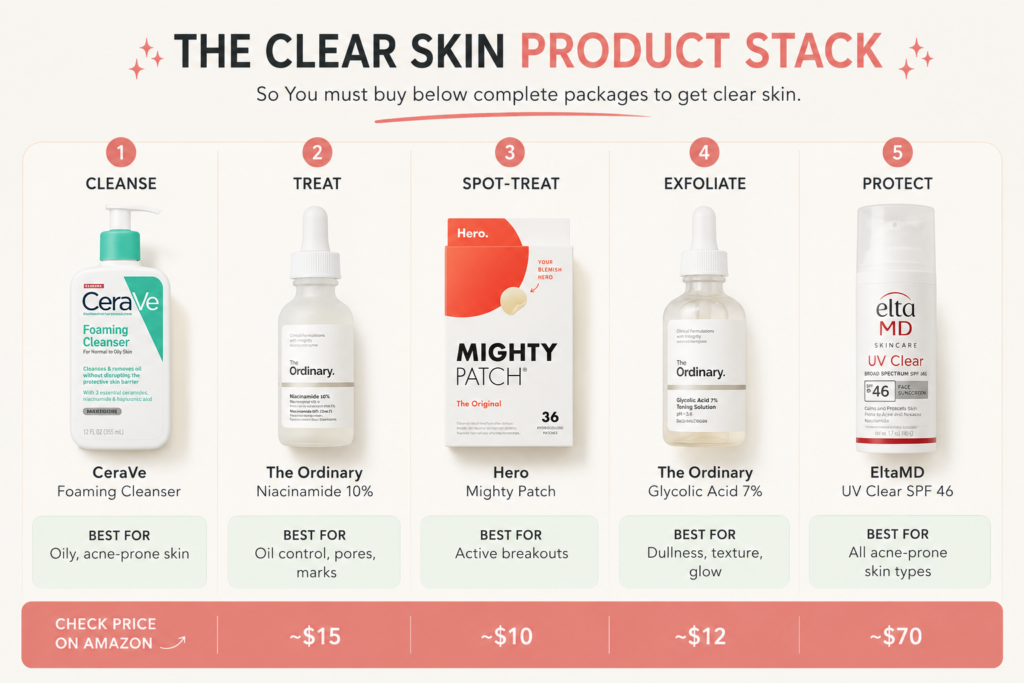
Summery: The Clear Skin Product Stack
So You must buy below complete packages to get clear skin.
| Product | Step | Best For | Price |
|---|---|---|---|
| CeraVe Foaming Cleanser | Cleanse | Oily, acne-prone skin | ~$15 |
| The Ordinary Niacinamide 10% | Treat | Oil control, pores, marks | ~$10 |
| Hero Mighty Patch | Spot-treat | Active breakouts | ~$14 |
| The Ordinary Glycolic Acid 7% | Exfoliate | Dullness, texture, glow | ~$12 |
| EltaMD UV Clear SPF 46 | Protect | All acne-prone skin types | ~$70 |
The Clear Skin Routine I Actually Follow
Here’s exactly what I do, laid out simply. This is the morning and evening routine I landed on after years of trial and error, and it’s been stable for over a year with consistent results.
Morning:
- CeraVe Foaming Cleanser (or just rinse with water if skin feels fine)
- The Ordinary Niacinamide 10% + Zinc — a few drops, patted in
- Lightweight oil-free moisturizer
- EltaMD UV Clear SPF 46
Evening:
- CeraVe Foaming Cleanser
- The Ordinary Glycolic Acid 7% toner — 2–3 nights a week, patted on with cotton pad (on glycolic nights, skip step 3)
- Niacinamide serum on non-glycolic nights
- Moisturizer with ceramides
If there’s a breakout: Mighty Patch overnight on any active whiteheads.
That’s it. Five products total. It took me far too long to learn that clarity comes from simplicity.
Clear Skin for Teens: What’s Actually Different
Teen skin is going through something genuinely unique — a hormonal surge that increases sebum production, often dramatically. This is why teenage acne tends to be oilier, more widespread, and more stubborn than adult acne.
A few things that matter specifically for teenage skin:
Don’t skip the moisturizer. This is the biggest mistake teen skin makes. Oily skin still needs moisture. Using heavy, drying products and no moisturizer is a cycle that makes oiliness worse.
SPF still matters at 16. The habits you build with sun protection in your teens are literally the habits that will determine how your skin ages over the next 30 years. Start now.
Don’t pick. I know. Impossible advice. But each picked spot can turn into a scar that takes 6–12 months to fully fade. Use Mighty Patches instead — they satisfy the urge to “do something” about a pimple without the damage.
Give products six to eight weeks before judging them. Teenage skin changes quickly and so does the temptation to switch products every two weeks when things don’t clear overnight. Consistency over six to eight weeks is what reveals whether something is actually working.
Why Your Skin Might Be Getting Worse Before It Gets Better
Something worth knowing: when you start a new skincare routine — especially when retinol or acids are involved — your skin often gets worse for a few weeks before it gets better. This is called purging.
Purging happens because active ingredients like retinol and AHAs speed up your skin’s cell turnover cycle. When cells turn over faster, the congestion and clogged pores that were sitting deep in your skin get pushed to the surface faster than they would naturally.
The result looks like a breakout but is actually your skin clearing out its backlog.
Purging typically happens in the areas you already break out in, not new areas. It usually settles within four to six weeks of consistent use. If you’re still breaking out at eight weeks, in new locations, or with products that don’t include actives — that’s a reaction, not a purge, and you should stop using the product.
This is also why the advice to “give it six to eight weeks” matters so much. Results in skincare are slow, non-linear, and easily confused with setbacks if you don’t know what you’re looking for.
When to See a Dermatologist Instead of Solving It Yourself
Clear skin is achievable for most people with the right routine and habits, but there are situations where OTC products genuinely won’t get you there and professional help is the right call.
See a dermatologist if:
- You have cystic or nodular acne — deep, painful lumps under the skin that never come to a head. These are bacterial and inflammatory at a level that topical products can’t reach. Oral antibiotics, spironolactone, or isotretinoin (Accutane) are often needed.
- Your breakouts are new or suddenly worsening in your 30s or 40s — this can be hormonal and is treatable with targeted approaches your GP or dermatologist can guide you through.
- You’ve consistently done a proper routine for three months with no improvement.
- You have hyperpigmentation or post-acne scarring that has been present for over a year with no improvement from OTC brightening ingredients.
A one-time dermatology appointment to understand your specific skin type and concerns is an investment that easily saves you years of guessing and product waste.
The Bottom Line on How to Get Clear Skin Overnight
Here’s everything distilled to its simplest form:
Repair your barrier before you treat anything. Gentle cleanser, simple moisturizer, SPF. Two weeks. Then build from there.
Use one active at a time. Niacinamide for oil and marks. BHA for congestion and blackheads. AHAs for texture and glow. Retinol for aging. Not all four simultaneously.
Be consistent more than you’re perfect. Doing a simple routine every day beats doing a complicated routine three times a week.
Your habits are part of your skincare routine. Sleep, diet, water, touching your face — they all show up on your skin.
Give things time. Skin cells take 28–40 days to turn over. Real results take 6–8 weeks minimum. Anything promising overnight transformation is selling you something.
Clear skin isn’t a destination you arrive at and stay at forever. It’s something you maintain, and on some days your skin just decides it’s going to do what it wants regardless of your routine. That’s normal. Work with your skin, not against it — and it’ll work with you eventually.
Internal Links for Further Reading
Looking for more targeted guidance? Here are some posts that go deeper on specific clear-skin topics:
- 🔗 How to Get Clear Skin Naturally — Home Remedies That Actually Work (link to your natural skincare post)
- 🔗 How to Build a Clear Skin Routine for Oily Skin (link to oily skin routine post)
- 🔗 How to Get Clear Skin for Teens: A No-Nonsense Guide (link to teen skincare post)
- 🔗 Glass Skin Routine: How to Get That Dewy, Poreless Look (link to glass skin post)
- 🔗 Best Eye Cream for Sensitive Skin: What Dermatologists Actually Recommend (link to your eye cream post)
- 🔗 Acne-Free Skin: A Complete Guide to Clearing Breakouts for Good (link to acne post)
- 🔗 Skincare for Beginners: The Only Routine You Need to Start With (link to beginner post)
Frequently Asked Questions
How long does it take to get clear skin? Realistically, 6–12 weeks of consistent routine. Some people see improvement in 2–3 weeks with the basics; others with deeper congestion or hormonal acne need longer. Clear skin is a marathon, not a sprint.
Can I get clear skin without spending a lot of money? Yes. CeraVe and The Ordinary together cost less than $30 and deliver clinical results. Clear skin is about the right ingredients used consistently — not about price.
Is clear skin possible with oily skin? Absolutely. Oily skin can achieve the same clarity and glow as any other skin type. The approach is slightly different — lightweight textures, niacinamide, salicylic acid, oil-free SPF — but oily skin also has advantages: it tends to age more slowly and develop fewer fine lines than dry skin.
Does diet really affect skin? For many people, yes. Dairy and high-glycemic foods (sugar, white bread, processed carbs) have documented links to acne exacerbation. This doesn’t affect everyone equally — some people can eat whatever they want with no skin impact.
But if you have persistent breakouts that aren’t responding to topical treatments, a dietary trial is worth doing.
What is “glass skin” and how do I get it? Glass skin is the Korean beauty term for skin that looks so clear, smooth, and hydrated that it appears almost translucent — like glass. Getting there involves consistent barrier care, thorough hydration, regular gentle exfoliation, and above all, staying out of the sun.
Products like niacinamide, hyaluronic acid, and a good AHA exfoliant used consistently over months will get you there more reliably than any trend ingredient.
This post is based on personal experience and publicly available dermatological guidance. It isn’t medical advice. For persistent or severe skin concerns, please consult a board-certified dermatologist.
Leave a Reply