
Finding the best sunscreen for sensitive skin often feels like an endless, painful cycle. You buy an SPF that promises to be “gentle” or “dermatologist-tested,” apply it with hope, and within hours—sometimes minutes—your face becomes red, itchy, burning, or breaks out in a rash.
Then, you spend the next week dealing with a damaged skin barrier and painful inflammation that feels worse than if you had just skipped sun protection entirely.
If you are hunting for a reliable sunscreen for rosacea, an acne-safe sunscreen, or a pure mineral sunscreen for sensitive skin that won’t trigger a flare-up, you are not alone.
I spent over 8 years testing sunscreens professionally and personally, evaluating more than 60 different formulas across various skin types and sensitivities. I have worked through severe sunscreen allergies of my own to figure out exactly what works when your skin rejects everything else.
This comprehensive guide reveals what dermatologists actually know about sun protection for reactive skin types, breaks down the specific ingredients that trigger contact dermatitis, and provides honest reviews of the only sunscreens that genuinely deliver results without the burn
Why Daily Sunscreen is Non-Negotiable for Sensitive Skin?
Many people with reactive skin make the ultimate mistake: they stop using sunscreen altogether. The logic seems sound—if sunscreen triggers a flare-up, avoiding it will calm the skin.
However, this creates a dangerous paradox. Sensitive skin almost always involves a compromised skin barrier. A healthy barrier consists of tightly packed skin cells held together by lipids and proteins.
When this shield is weakened by genetics, over-exfoliation, or environmental stressors, your skin loses moisture quickly and becomes highly vulnerable to irritants.
Unprotected UV exposure acts like fuel to an inflammatory fire. It triggers a cellular stress cascade that deepens redness, worsens rosacea or eczema, and accelerates collagen breakdown.
According to a 2017 study published in Photochemistry and Photobiology, standard car window glass blocks only about 48% of UVA rays. This means that even on cloudy days or while sitting indoors, ambient UV radiation is actively degrading your skin barrier. Daily SPF is not just about avoiding sunburn; it is your single most powerful daily anti-inflammatory treatment.
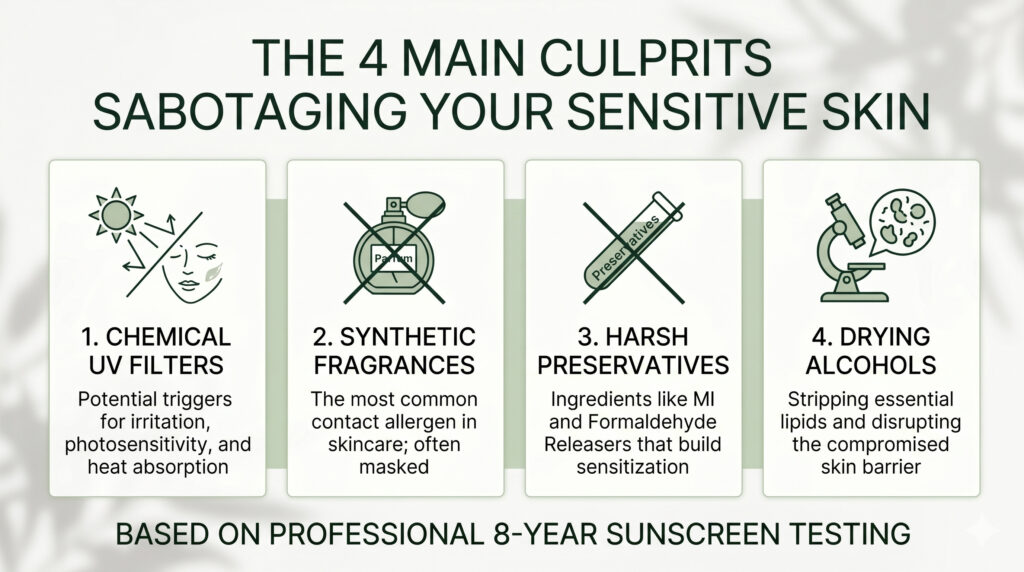
The 4 Main Culprits Sabotaging Your Senitive Skin
Before buying a product, you must know how to audit the label. Almost every sunscreen reaction can be traced back to one of these four common irritants:
1. Synthetic Fragrances & “Natural” Essential Oils
Fragrance is the number one trigger for contact dermatitis in skincare. Under current regulatory guidelines, manufacturers can list the umbrella term “Fragrance” or “Parfum” to mask up to 3,000 different chemical compounds without disclosing them.
Don’t let “natural” alternatives fool you, either. Essential oils like lavender, citrus, peppermint, and eucalyptus are highly volatile organic compounds. A 2019 dermatological study found that lavender oil caused allergic contact dermatitis in 14% of patients with sensitive skin. When heated by the sun on your face, these oils activate further, intensifying skin burning.
- Red Flags: Fragrance, Parfum, Lavender Extract, Citrus Peel Oil, Mentha Piperita, Botanical Blend.
2. Chemical UV Filters (The Systemic Absorption Risk)
Chemical (organic) filters work by absorbing into the skin, converting UV rays into heat, and releasing that heat from the body. This heat conversion process frequently triggers localized inflammation and flushing in vascular or rosacea-prone skin.
Furthermore, a landmark 2019 FDA study revealed that common chemical filters like Avobenzone, Oxybenzone, and Octinoxate absorb through the skin barrier and enter the bloodstream at levels that warrant further safety evaluation. For a compromised barrier, this absorption happens even faster, leading to a higher risk of systemic sensitization and photosensitive stinging.
3. Drying Alcohols
To make heavy sunscreens feel lightweight and “dry-touch,” formulators often load products with low-molecular-weight volatile alcohols. These ingredients dissolve the crucial lipids (ceramides and fatty acids) that glue your skin barrier together.
- Red Flags: Alcohol Denat., Isopropyl Alcohol, SD Alcohol 40.
4. Harsh Preservatives
Sunscreens require robust preservative systems to prevent bacterial growth. However, certain options are notorious allergens.Also, Methylisothiazolinone (MI), often used in “paraben-free” marketing setups, has seen its sensitization rates skyrocket tenfold over the past decade.
So, Formaldehyde-releasers (like DMDM Hydantoin) are also slow sensitizers—meaning you might be completely fine during the first week of use, but develop a severe rash by week three.
Mineral vs. Chemical Sunscreen: The Definitive Comparison
Dermatologists almost universally recommend pure mineral (physical) sunscreens for reactive skin. Mineral filters sit on top of the skin’s surface like microscopic mirrors to reflect UV rays away, rather than absorbing into the tissue.
In particular, Zinc Oxide is an unsung skincare hero. It is physically too large to penetrate an intact barrier (with typical micronized particles measuring 200–300 nanometers), and it is inherently anti-inflammatory—which is why it serves as the active ingredient in medical wound healing and diaper rash creams.
| Feature | Mineral (Physical) Sunscreens | Chemical (Organic) Sunscreens |
| Primary Ingredients | Zinc Oxide, Titanium Dioxide | Avobenzone, Oxybenzone, Octinoxate, Octisalate |
| Mechanism | Rests on top of skin; reflects & scatters UV | Absorbs into tissue; converts UV to heat |
| Irritation Risk | Extremely Low (0.5%–1% sensitization) | Moderate to High (8%–15% sensitization) |
| Speed of Action | Effective immediately upon application | Requires 15–20 minutes to absorb and activate |
| Skin Benefits | Anti-inflammatory; helps soothe redness | Can cause pro-inflammatory heat flushing |
| White Cast | Common in traditional formulas | Transparent/invisible finish |
Understanding SPF Numbers: The Percentage Game
Many consumers buy SPF 100 thinking it provides double the protection of SPF 50. In reality, the protection scale is not linear:
- SPF 15 blocks 93% of UVB rays
- SPF 30 blocks 97% of UVB rays
- SPF 50 blocks 98% of UVB rays
- SPF 100 blocks 99% of UVB rays
To gain that minor 1% jump from SPF 50 to 100, brands must dramatically increase the concentration of chemical filters and chemical stabilizers. For sensitive skin, SPF 30 to 50 is the absolute sweet spot—offering maximum real-world protection with minimal risk of chemical overload.
5 Best Sunscreens for Sensitive Skin: Detailed Reviews & Expert Analysis
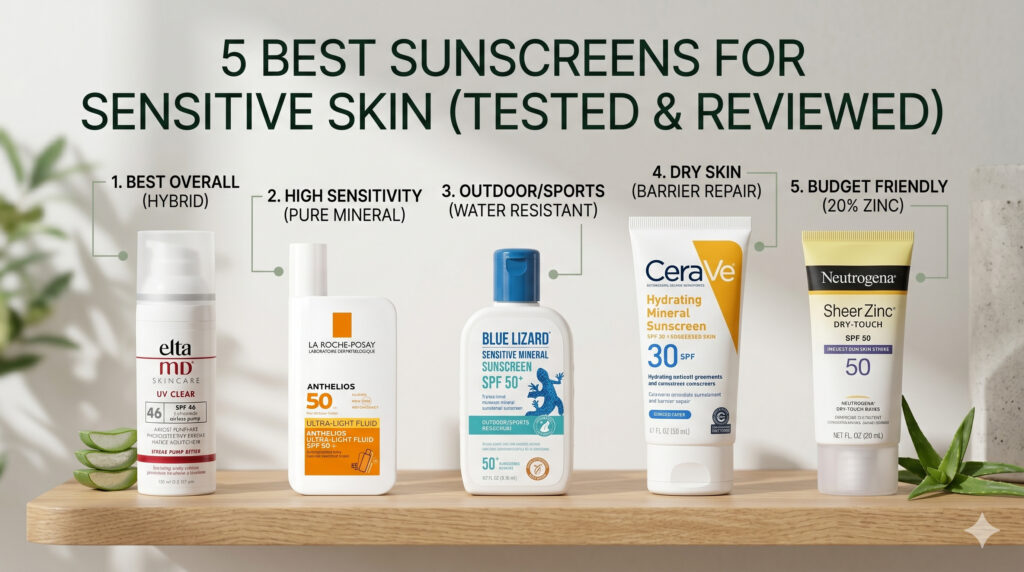
1.EltaMD UV Clear Broad-Spectrum SPF 46 — Best Overall
Product Type: Hybrid sunscreen (Mineral + Chemical)
Mineral Content: 7.5% Zinc Oxide
Chemical Filter: 3% Avobenzone (proprietary HPF complexation makes it stable and less irritating)
Price Point: $$$ (approximately $40 USD)
Why This Ranks #1:
Furthermore, EltaMD UV Clear is what dermatologists call the “gold standard” for sensitive, acne-prone, and rosacea-prone skin—and it’s the only sunscreen I’ve heard prescribed as a medical treatment rather than just a recommendation.
Complete Ingredient Breakdown:
Active Ingredients (UV Filters):
- 7.5% Zinc Oxide (physical filter, anti-inflammatory)
- 3% Avobenzone (in stabilized HPF form)
This combination offers UVA/UVB protection without the heavy, occlusive feel of a 20% zinc oxide formulation alone.
Key Beneficial Ingredients:
- 5% Niacinamide (Vitamin B3): Reduces redness, regulates sebum, strengthens barrier, fades hyperpigmentation
- Hyaluronic Acid: Holds water in the skin (up to 1000x its weight in hydration)
- Sodium PCA: Natural humectant, hygroscopic (pulls water from air into skin)
Formula Type: Ultra-lightweight serum texture
Finish: Matte to natural (zero white cast on all skin tones)
UVA Protection: Excellent (broad-spectrum with emphasis on long-wave UVA)
Pros:
- Ultra-lightweight fluid texture (feels like a serum, not sunscreen)
- Zero white cast—wears beautifully under makeup
- Active redness-reduction technology (the niacinamide actually treats rosacea while protecting)
- Fades dark spots and post-inflammatory hyperpigmentation
- Oil-free formula
- Completely fragrance-free and paraben-free
- Won’t clog pores (excellent for acne-prone skin)
- Dermatologist-developed and prescribed
Cons:
- Premium price ($40 for 1.7 oz is expensive per ounce)
- Requires 15-minute wait time before sun exposure (chemical filter component)
- Not reef-safe (not a concern for sensitive skin, but important for eco-conscious consumers)
- Can occasionally feel slightly sticky in very humid climates
Best For:
- Sensitive skin with rosacea
- Acne-prone sensitive skin
- Hyperpigmentation concerns
- Anyone who wears makeup over sunscreen
- People with previous sunscreen allergies who need something dermatologist-tested
How to Apply: Squeeze 2 parallel lines of product down index and middle fingers, apply to face and neck, wait 15 minutes before sun exposure or makeup application.
Cost Per Application: Approximately $2.35 per application (reasonable given the active treatment benefits)
2. La Roche-Posay Anthelios Mineral Ultra-Light Fluid SPF 50 — Best for High Sensitivity
Product Type: Pure Mineral (Physical Only)
Mineral Content: Zinc Oxide + Titanium Dioxide (exact percentages proprietary but estimated 20%+ total)
Price Point: $$ (approximately $30-32 USD)
Why This Ranks #2:
La Roche-Posay is a French pharmaceutical pharmacy brand with over 50 years of dermatological history. But, The Anthelios line is specifically designed for people who have failed with other sunscreens.
So, this is the “nuclear option” if you have severe skin reactivity, active flares, or multiple sunscreen allergies in your history.
Complete Ingredient Analysis:
Active Ingredients:
- Zinc Oxide (primary mineral filter)
- Titanium Dioxide (secondary mineral filter)
- Estimated combined concentration: 20-25% mineral content
Key Beneficial Ingredients:
- La Roche-Posay Thermal Spring Water: Infused with antioxidants (selenium, zinc, copper), naturally calming and bioactive
- Hyaluronic Acid (HA): Hydration component—holds moisture against evaporation
- Silicones: Help create texture without silicone-induced irritation (high-purity, non-comedogenic silicones)
Formula Type: Watery fluid (shake-to-activate texture)
Finish: Ultra-matte to dewy (depends on skin oiliness)
UVA Protection: Excellent broad-spectrum
Pros:
- 100% pure mineral filters—zero chemical filter controversy
- Shake-to-activate technology creates a lightweight watery texture despite high mineral concentration
- Infused with antioxidant-rich La Roche-Posay thermal spring water (bioactive, not just water)
- Fragrance-free, paraben-free, preservative-minimalist formula
- Accepted by the National Eczema Association (rare and clinically meaningful endorsement)
- Fast-absorbing (no wait time required, works immediately)
- Excellent for extremely reactive skin, active eczema, or active rosacea
- Reef-safe
Cons:
- Can leave a slight to moderate white cast on deeper skin tones (this is physical, unavoidable with high mineral concentrations)
- Requires shaking before each application (the shake-to-activate means minerals settle)
- Slightly grittier texture than some chemical formulas
- Bottle size is smaller (1.7 oz) than some competitors
- Not ideal for oily skin types (the watery texture can feel matte on already-matte skin)
Best For:
- Severely reactive skin or multiple sunscreen allergies
- Active eczema or dermatitis
- Active rosacea flares
- People with previous allergic reactions to mineral sunscreens wanting higher concentration
- Anyone needing immediate protection (no wait time)
3. Blue Lizard Sensitive Mineral Sunscreen SPF 50+ — Best for Outdoor & Sports
Product Type: Pure Mineral
Mineral Content: Zinc Oxide + Titanium Dioxide (combined 16%)
Price Point: $$ (approximately $12-14 USD for 5 oz)
Water Resistance: 80+ minutes (exceptional)
Why This Ranks #3:
Blue Lizard was born from the Australian sun—this brand literally designed sunscreen for one of the harshest UV environments on Earth. It’s formulated by dermatologists to withstand extreme conditions (beach, pool, intense sweat) while remaining safe for sensitive skin.
So , this is the practical choice if you have sensitive skin but an active lifestyle (sports, swimming, outdoor work).
Complete Ingredient Analysis:
Active Ingredients:
- 14% Zinc Oxide
- 2% Titanium Dioxide
- Total mineral content: 16%
Key Features:
- Smart Bottle Technology: Bottle changes color in harmful UV light (visual reminder to reapply)
- Micronized Mineral Filters: Particles reduced to minimize white cast
- Water-resistant formulation: Protected for up to 80 minutes in water
Formula Type: Thicker cream (intentionally dense for water resistance)
Finish: Slight white cast, but blendable
UVA Protection: Broad-spectrum, strong UVA protection
Pros:
- Extremely water-resistant (80+ minutes beats most competitors)
- One of the most affordable mineral options per ounce ($2.40-2.80 per ounce)
- Smart bottle technology is genuinely useful as a reapplication reminder
- Free from fragrances, parabens, and chemical filters
- Reef-safe formula (safe for coral and marine ecosystems)
- Excellent for sensitive skin prone to heavy sweating
- Thicker consistency means it stays where you apply it (doesn’t run with sweat)
- Value pricing makes frequent reapplication affordable
Cons:
- Thicker, creamier texture (requires more effort to blend)
- White cast more noticeable than EltaMD or some competitors
- Takes 15 minutes to fully set before swimming (water resistance time doesn’t start until fully set)
- Not formulated specifically for facial application (it’s equally suited to body)
- Less cosmetically elegant than premium brands
Best For:
- Beach days and pool use
- Outdoor sports and activities
- People with sensitive skin who sweat heavily
- Budget-conscious shoppers who want value without sacrificing safety
- Anyone prioritizing water resistance over cosmetic elegance
Reapplication Reality: With 80-minute water resistance, you genuinely only need to reapply after 80 minutes in water OR after toweling off. This is significantly better than most sunscreens.
4. CeraVe Hydrating Mineral Sunscreen SPF 30 — Best for Dry, Compromised Skin
Product Type: Pure Mineral
Mineral Content: Zinc Oxide + Titanium Dioxide (combined 17.3%)
Price Point: $ (approximately $10-12 USD for 1.69 oz)
Why This Ranks #4:
If your skin barrier is so compromised that even “gentle” sunscreens sting, this is your answer. CeraVe formulated this specifically for extremely dry, peeling, or damaged skin barriers.
The inclusion of 3 essential ceramides is clinically meaningful—these ceramides are the exact lipids your barrier needs to repair itself.
Complete Ingredient Analysis:
Active Ingredients:
- 14% Zinc Oxide
- 3.3% Titanium Dioxide
Skin Barrier Repair Complex:
- Ceramide NP (Ceramide 3): Critical for water-holding capacity
- Ceramide AP (Ceramide 6-II): Essential for barrier structure
- Ceramide EOP (Ceramide 1): Supports lamellar organization of barrier lipids
- Hyaluronic Acid: Holds water in skin (up to 1000x its weight)
- Glycerin: Humectant and plasticizer (keeps skin plump and flexible)
- MVE Technology: Proprietary encapsulation that releases moisturizing ingredients throughout the day
Formula Type: Rich, creamy texture
Finish: Moist and dewy
UVA Protection: Broad-spectrum, adequate
Pros:
- 3 essential ceramides at clinically effective concentrations (research-backed)
- Doubles as a hydrating moisturizer (some users skip moisturizer on days they use this)
- Hyaluronic acid + Glycerin + Ceramides = exceptional hydration
- Accepted by the National Eczema Association
- Extremely affordable
- Fragrance-free, paraben-free
- Excellent for eczema-prone skin even during active flares
- Long-time trusted brand with extensive dermatological backing
Cons:
- Richer texture feels greasy on oily or combination skin types
- Noticeable white cast (higher mineral concentration + creamy base makes this unavoidable)
- Only SPF 30 (lower than competitors, though still adequate for daily use)
- Takes longer to set than lightweight formulas
- Not ideal for makeup application (the rich texture can shift makeup)
Best For:
- Extremely dry, peeling, or flaky sensitive skin
- Compromised skin barriers from over-treatment or dermatitis
- Eczema-prone skin
- Post-procedure skin (after microdermabrasion, chemical peels, laser)
- Anyone needing intense hydration + sun protection in one product
- Budget-conscious consumers (excellent price for effectiveness)
Realistic Assessment: This is not the most elegant sunscreen, but it’s genuinely therapeutic. If your skin barrier is severely compromised, cosmetic elegance is secondary to healing—and this formula prioritizes healing.
5. Neutrogena Sheer Zinc Dry-Touch SPF 50 — Best Budget-Friendly Option
Product Type: Pure Mineral
Mineral Content: 20% Zinc Oxide (naturally sourced)
Price Point: $ (approximately $7-8 USD for 3 oz)
Why This Ranks #5:
Sometimes, the best sunscreen is the one you’ll actually use—and cost is often the barrier. Neutrogena Sheer Zinc delivers legitimate mineral protection at a drugstore price point. It’s not the most sophisticated formula, but it’s safe and effective.
Complete Ingredient Analysis:
Active Ingredients:
- 20% Zinc Oxide (naturally sourced, micronized)
Notable Features:
- Neutrogena Dry-Touch Technology: Proprietary formula that reduces the occlusive, heavy feeling of traditional zinc sunscreens
- Oil-free formulation: Won’t clog pores or feel greasy
- Hypoallergenic: Minimalist ingredient list
Formula Type: Medium-weight lotion
Finish: Matte (high zinc concentration ensures this)
UVA Protection: Broad-spectrum
Pros:
- Extremely affordable and widely available (Walmart, Target, grocery stores)
- 20% zinc oxide is a solid concentration for effective protection
- Truly oil-free (doesn’t clog pores)
- Hypoallergenic and fragrance-free
- Water-resistant for 80 minutes
- Sweat-resistant
- No guesswork on availability or sourcing
Cons:
- White chalky cast on medium to dark skin tones (this is literal zinc oxide, unavoidable)
- Less elegant texture and feel compared to premium brands
- Takes slightly longer to blend than optimized formulas
- Not tinted (unlike some newer budget options)
- Minimal beneficial ingredients (it’s purely sun protection, no treatment benefits)
Best For:
- Pale/fair skin tones where white cast isn’t noticeable
- Budget shoppers who want legitimate mineral protection
- Daily incidental sun exposure (not extended outdoor activity)
- Outdoor enthusiasts on a budget (the price lets you apply more generously without guilt)
- Anyone needing to replace sunscreen frequently (sweat, water sports, active lifestyle)
Realistic Use Case: This is the sunscreen you use when you’re not worried about perfection—the backyard BBQ, the kids’ soccer game, casual outdoor time. It works, it’s safe, and it doesn’t cost $40 per bottle.
Buying Guide: Match Your Secondary Skin Concern
Sensitive + Acne-Prone
What to look for:
- Niacinamide (sebum regulation + redness reduction)
- Oil-free formula
- Non-comedogenic ingredients
- Avoid occlusive, heavy bases
Top Pick: EltaMD UV Clear (the niacinamide actively treats acne while protecting)
Why: The 5% niacinamide concentration is therapeutic for acne. It regulates sebum production, reduces inflammation, and doesn’t clog pores.
Sensitive + Dry/Flaky
What to look for:
- Ceramides (barrier repair)
- Hyaluronic acid (water-holding)
- Glycerin (humectant and plasticizer)
- Rich, nourishing texture
- Avoid drying alcohols entirely
Top Pick: CeraVe Hydrating Mineral Sunscreen (3 essential ceramides + HA + Glycerin)
Why: The combination of ceramides at clinical concentrations actually repairs your barrier while protecting it. This is the only sunscreen that doubles as targeted barrier therapy.
Sensitive + Oily/Shiny
What to look for:
- Mattifying texture or “dry-touch” technology
- Lightweight fluid consistency
- Oil-free formula
- Non-occlusive minerals
Top Pick: EltaMD UV Clear or La Roche-Posay Anthelios (both have lightweight, non-greasy finishes)
Why: Both offer clean, light textures that won’t feel heavy or look shiny. EltaMD has superior mattification technology; La Roche-Posay has faster absorption.
Sensitive + Rosacea-Prone
What to look for:
- High zinc oxide concentration (inherently anti-inflammatory)
- Ingredients with redness-reducing properties (niacinamide, sulfur alternatives)
- Avoid heat-conversion formulas (chemical filters)
- Fragrance-free and dye-free
Top Pick: EltaMD UV Clear (combination of 7.5% zinc oxide + 5% niacinamide specifically targets rosacea)
Why: EltaMD was specifically formulated for rosacea sufferers. The zinc oxide reduces existing redness, and niacinamide prevents flares by strengthening the barrier.
Sensitive + Active Eczema/Severe Dermatitis
What to look for:
- Pure mineral filters only (no chemical debate)
- National Eczema Association acceptance (clinically meaningful endorsement)
- Minimal preservatives
- Soothing, anti-inflammatory ingredients
- Creamy or fluid texture (depends on skin preference)
Top Pick: La Roche-Posay Anthelios Mineral Fluid (most reactive-skin-friendly formula)
Why: The combination of pure minerals, thermal spring water, and minimal preservatives is the safest bet when your skin is actively flaring. The eczema association approval is meaningful.
The 3 Critical Sunscreen Mistakes You’re Probably Making (That Cause Reactions Even in Safe Formulas)
You may be using one of the best sunscreens for sensitive skin and still experience redness, irritation, or sun damage. Why? Because the way you apply sunscreen is just as important as the formula itself.
Many people unknowingly make a few common mistakes that reduce protection and leave sensitive skin vulnerable to inflammation. Here are the three biggest ones to avoid.
Mistake 1: Applying Only 25% of the Amount You Need (The Most Common Error)
Studies show that the average person applies only 0.5-1 mg/cm² of sunscreen, while protection claims are based on 2 mg/cm². This means you’re getting approximately SPF 7-12 from an SPF 50 sunscreen.
How much you actually need:
For face + neck + ears + upper chest (the “golden triad”), use two parallel lines of product down your index and middle fingers. This might sound like a lot, but it’s the clinically tested amount.
Specific measurements:
- Face only: approximately ¼ teaspoon
- Face + neck: approximately ½ teaspoon
- Face + neck + ears + chest: approximately 1 teaspoon
Application technique that matters:
- Dispense the full amount into your palm
- Warm the product between your palms for 2-3 seconds
- Press (don’t rub) onto face, allowing the warmth to help it spread
- Use gentle pressing motions, not rubbing—this prevents disrupting the sun-protective layer
- Pay special attention to: temples, hairline, ear tops, behind ears, jawline, neck, upper chest
- Wait 15 minutes (for chemical filter component in hybrid sunscreens) before sun exposure or makeup
The under-application consequence for sensitive skin: When you apply too little, you’re essentially creating a weakened barrier of protection with gaps. UV rays penetrate these gaps and trigger intense localized inflammation in sensitive skin—often worse than if you’d applied nothing.
Mistake 2: Forgetting to Reapply (Especially After Sweating, Swimming, or Toweling Off)
Mineral sunscreen sits physically on top of your skin. As you sweat, touch your face, talk on the phone, wear a hat, or get wet, that physical layer rubs off.
Real-world reapplication schedule:
- Every 2 hours if directly in sun (not just in sunlight, but direct, unobstructed sunlight)
- Immediately after swimming or heavy sweating (don’t wait for 2-hour mark)
- After using absorbent towels (even patting dries, not rubbing)
- After wearing hats or sunglasses (the friction removes product)
Why this matters for sensitive skin: If you apply adequate sunscreen in the morning but forget to reapply at lunch, you’re unprotected for afternoon sun exposure—the time when UV intensity is peak. A single 4-hour unprotected exposure to peak sun can trigger inflammatory cascades that take weeks to resolve in sensitive skin.
Practical reapplication for makeup wearers: If you’re wearing makeup, reapplication is tricky. Options:
- Use a powder sunscreen on top of makeup (products like Colorescience or PowderFX)
- Use SPF-containing powder or foundation (though these typically don’t provide sufficient SPF without reapplication)
- Use a sunscreen mist spray (less optimal, as they don’t layer well with makeup, but better than nothing)
- Plan indoor time during peak hours (11 AM–3 PM) to minimize reapplication needs
Mistake 3: Ignoring the Golden Triad (Ears, Neck, Décolletage)
These three areas have the thinnest, most delicate skin on your face and body—and they’re often the first places to develop:
- Premature wrinkles and laxity
- Severe sun damage and discoloration
- Actinic keratosis (pre-cancerous lesions)
- Severe contact dermatitis (because the skin is so thin, reactions are more intense)
Why this happens: The epidermis (top layer of skin) is only 0.06 mm thick on your face, but only 0.01 mm thick on your ears and neck. Less protective tissue means UV rays penetrate deeper and cause more damage per unit of exposure.
The neck and chest are also notorious for being under-treated—people naturally think of “face” sunscreen but forget that the neck and upper chest receive nearly as much sun exposure and age just as visibly.
Golden Triad application protocol:
- Apply sunscreen in a line from below chin, down the entire front of the neck
- Cover the back of the neck and neck sides completely
- Apply generous amounts to both ears (front and back—the back of ears is especially vulnerable)
- Extend sunscreen down to the collarbones and across the upper chest
- Don’t stop at the jawline—this creates a visible sun damage line
How to Patch Test a New Sunscreen: The 48-Hour Safety Protocol
Before applying any new sunscreen to your face, a simple patch test prevents full-scale flare-ups or allergic reactions.
Step-by-step patch test procedure:
- Choose a hidden area: Behind the ear (most realistic for skin thickness and sensitivity), inside of the wrist, or inside of the forearm
- Apply a dime-sized amount: Approximately 0.5 ml is sufficient for testing. Don’t just apply a tiny speck—you need enough that absorption or reaction is possible
- Leave it on for 24-48 hours: The longer you wait, the more accurate your results. Some delayed-type hypersensitivity reactions take 24-48 hours to manifest
- Don’t wash the area: Resistance is natural, but washing removes the product and nullifies the test
- Observe for:
- Redness or flushing
- Itching or burning sensation
- Tiny bumps or hives
- Swelling
- Any warmth or heat sensation
- Dryness or flaking in the specific test area
- If completely normal after 48 hours: Apply to a small facial area (temple) for 3-5 days before full-face application
- If ANY reaction occurs: Discontinue immediately and wait for the reaction to resolve before trying another product
Why 48 hours matters: Some contact allergens don’t trigger immediate reactions. Parabens, MI (methylisothiazolinone), and formaldehyde-releasers often show 24-48 hour delayed reactions. If you test for only 2 hours and apply to your face, you might not experience a reaction until the product is already absorbed and sitting against your skin barrier for hours.
FAQ: What Dermatologists Actually Know About Sunscreen for Sensitive Skin
Q1: Is SPF 100 twice as protective as SPF 50?
A: No, and this is critical to understand because it changes your product choices.
SPF 30 blocks 97% of UVB rays and SPF 50 blocks 98%. SPF 100 blocks nearly 99%.
The difference between SPF 50 and SPF 100 is literally 1% additional protection. To achieve that extra 1%, manufacturers typically:
- Increase chemical filter concentrations (more irritation potential)
- Add higher preservative levels (increased allergy risk)
- Include additional stabilizing compounds (more ingredients = more potential allergens)
For sensitive skin, SPF 50 is the optimal sweet spot. You get excellent protection (98% of UVB rays blocked) without the increased irritation risk of higher formulations.
The only exception: if you’re someone who applies less than the recommended amount (which most people do), then SPF 50 might provide something closer to SPF 30 protection due to your under-application. In this case, using SPF 50+ helps compensate for human error.
Q2: Can sensitive skin ever safely use chemical sunscreens?
A: Yes, but only under specific circumstances, and mineral is always safer.
Modern chemical sunscreen formulations have become more stable and less irritating than they were 5-10 years ago. Some newer chemical filters like Tinosorb S and Tinosorb M have better safety profiles.
When you CAN consider chemical sunscreens:
- Your skin is calm and not currently flaring
- You’ve successfully patch-tested and tolerated chemical filters in the past
- You prefer the cosmetic elegance of chemical sunscreens enough to accept slightly higher irritation risk
- You’re willing to rbest eapply every 2 hours scrupulously (chemical filters degrade faster)
When you CANNOT use chemical sunscreens:
- You’re experiencing an active flare of rosacea, eczema, or dermatitis
- You have a history of photosensitivity or photosensitive reactions
- You’ve previously reacted to avobenzone, oxybenzone, or octinoxate
- Your skin barrier is severely compromised (physical damage, dermatitis, over-treatment)
- You have multiple fragrance or preservative allergies (chemical sunscreen formulas often need more stabilizers)
Dermatologist consensus: For baseline safety, mineral sunscreen is superior. Consider chemical only if mineral formulas consistently fail for you cosmetically.
Q3: Why do mineral sunscreens leave a white cast, and can you avoid it?
A: Zinc Oxide and Titanium Dioxide are literally white minerals—the same compounds used to manufacture white paint.
The white cast comes from:
- Particle size: Larger particles (older technology) scatter light more visibly, creating the chalky appearance
- Concentration: Higher concentrations (20%+) have more visible white cast
- Deeper skin tones: The white mineral shows more obviously against darker skin, creating a contrast-visible cast
Modern solutions to minimize white cast:
- Micronization: Modern technology reduces particle size from 100+ nanometers to 5-50 nanometers, reducing light scattering
- Tinting: Some brands add iron oxides (natural minerals) to match skin tone (e.g., Colorescience Sunforgettable, La Roche-Posay with tint)
- Formula optimization: Using silicones and light-diffusing powders to make the white less visible
- Lower concentrations: Formulas using 10-15% minerals have less cast than 20%+ formulas
What you can realistically expect:
- Fair skin (Fitzpatrick I-II): Usually unnoticeable white cast with modern formulas
- Light/Medium skin (Fitzpatrick III-IV): Slight white cast, diminishes as it sets (5-10 minutes)
- Medium/Tan skin (Fitzpatrick IV-V): Moderate white cast, somewhat noticeable but blendable
- Deep/Dark skin (Fitzpatrick V-VI): More noticeable white cast, options include tinted mineral sunscreens or hybrid formulas
If white cast is a dealbreaker: You have options:
- Use a tinted mineral sunscreen (Colorescience, Isdin, La Roche-Posay Anthelios with tint)
- Use a hybrid formula with lower mineral concentration (EltaMD UV Clear is only 7.5% zinc oxide, much less cast)
- Consider chemical sunscreens if you’ve tolerated them (they have zero white cast)
Q4: What’s the difference between “reef-safe” and “reef-harmful” sunscreens, and does it matter for sensitive skin?
A: The concern is legitimate for ocean health, but doesn’t directly affect sensitive skin safety.
The reef issue: Oxybenzone and Octinoxate (chemical filters) are proven to damage coral reef ecosystems. Hawaii and some other regions have banned these ingredients in sunscreens sold in coastal areas to protect marine ecosystems.
Reef-safe alternatives:
- All mineral sunscreens (zinc oxide and titanium dioxide) are reef-safe
- Some newer chemical filters (Tinosorb S, Tinosorb M) are reef-safe
- Check label claims: “Reef-Safe” or “Reef Friendly” indicates safer formulation
For sensitive skin specifically: Reef-safe designations don’t directly make something safer for sensitive skin. However, the filters that are reef-harmful (oxybenzone, octinoxate) are also more irritating to sensitive skin. So reef-safe formulations often overlap with sensitive-skin-safe formulations.
If you care about reef health: Any mineral sunscreen automatically checks this box.
Q5: Should I use sunscreen even on cloudy days?
A: Yes, absolutely, and this is especially important for sensitive skin.
The UV penetration reality:
- Cloudy days: Up to 80% of UV rays penetrate clouds
- Windows: Regular glass blocks UVB but lets most UVA through; car windows block about 48% of UVA
- Reflective surfaces: Snow and water reflect and amplify UV exposure
For sensitive skin specifically: Because your barrier is already compromised, even “ambient” UV exposure that wouldn’t bother normal skin can trigger inflammation. UV rays damage collagen (causing aging) and trigger inflammatory cascades even without visible sunburn.
The practical schedule:
- Daily, indoors: SPF 30 is adequate
- Cloudy outdoor days: SPF 30-50 same as sunny days
- Sunny days with extended outdoor time: SPF 50
- Intense outdoor activity (beach, hiking, sports): SPF 50+
Q6: Can I use old sunscreen from last summer?
A: Only if you know it was stored properly.
Sunscreen stability depends on:
- Storage temperature: Sunscreen stored above 77°F (25°C) degrades faster. If you left it in a hot car, bathroom with shower steam, or in direct sunlight, the UV filters have likely broken down
- Light exposure: UV light breaks down UV filters (ironic but true)
- Age: Even properly stored sunscreen degrades over time, typically within 1-2 years
Best practice:
- Check the expiration date on the bottle
- If no expiration date, assume 2-year stability from purchase
- Store sunscreen in a cool, dark place (bedroom drawer, not bathroom)
- Keep a new bottle each season if you’re not sure about storage
For sensitive skin: Using degraded sunscreen is worse than using no sunscreen because you might feel protected while actually getting inadequate UVA/UVB coverage—leading to more intense UV reactions.
Q7: Can I mix sunscreen with my moisturizer or foundation to make application easier?
A: No, and this is a common mistake.
Why mixing doesn’t work:
- SPF is rated at 2 mg/cm² concentration. Diluting sunscreen with moisturizer or foundation means you’re applying it at 0.5-1 mg/cm² concentration
- The protective layer becomes discontinuous with gaps where UVB penetrates
- You’re essentially reducing SPF 50 to SPF 15-20
What to do instead:
- Apply moisturizer, wait 1 minute for it to set
- Apply full amount of sunscreen
- Wait 1 minute, then apply foundation/makeup
It’s one extra step in your routine, but it’s the difference between 98% UV protection and 50% protection.
Q8: Is vitamin C in sunscreen safe for sensitive skin?
A: Only specific forms, and this matters.
Vitamin C in sensitive skin products:
- L-Ascorbic Acid: Most bioactive form, but highly unstable and can cause irritation; avoid unless your barrier is completely healed
- Magnesium Ascorbyl Phosphate: More stable, less irritating; okay for sensitive skin
- Ascorbyl Palmitate: Oil-soluble, very stable, minimal irritation risk; fine for sensitive skin
The practical answer: If a sunscreen contains vitamin C, check which form. If it lists “Magnesium Ascorbyl Phosphate” or “Ascorbyl Palmitate,” it’s generally safe. If it says “L-Ascorbic Acid” or “Ascorbic Acid,” be cautious or skip it unless your skin is completely stable.
My Personal Sunscreen Allergy Story: How I Finally Fixed It
I spent years assuming my skin simply “hated sunscreen.” I’d purchase highly-rated products—sometimes spending $50-60 per bottle—only to experience the same reaction: burning, stinging, redness, and hives that would last 3-5 days.
The turning point came when I finally sat down with a dermatologist and brought the ingredients list with me. She took 30 seconds to identify the culprits: denatured alcohol (Alcohol Denat. listed as the third ingredient) and fragrance (listed as the seventh).
The product was actually a “premium” luxury brand with thousands of five-star reviews. I had assumed that if thousands of people loved it, my reaction was my problem, not the product’s.
I switched to 100% fragrance-free, mineral-only formulas. Within two weeks, my baseline redness decreased. By four weeks, I could apply sunscreen without any burning sensation. After eight weeks, my skin was genuinely calmer than it had been in years.
The lesson that changed everything: Never buy a product because it’s viral or highly-reviewed. Buy it because the ingredient list aligns with your skin’s biology.
I now maintain a simple rule: I screenshot the ingredient lists of any sunscreen I’m considering, scan specifically for fragrance, alcohol, and problematic preservatives, and only test products that pass that screen. It sounds obsessive, but it’s actually faster than my previous trial-and-error approach, and it’s saved thousands of dollars in failed purchases.
Final Verdict: Which Sunscreen Should You Actually Buy?
The honest answer: It depends on your specific skin profile and what irritates you personally. But here’s the decision tree:
If You Have Rosacea or Persistent Redness:
Best Choice: EltaMD UV Clear Broad-Spectrum SPF 46
The combination of 7.5% zinc oxide (inherently anti-inflammatory) and 5% niacinamide (reduces rosacea flares) makes this the only sunscreen that actively treats while protecting. Yes, it’s expensive, but it’s also prescribed by dermatologists as a medical skincare product, not just a cosmetic. The cost is justified by the results.
If You Have Severe Skin Reactivity or Active Flares:
Best Choice: La Roche-Posay Anthelios Mineral Ultra-Light Fluid SPF 50
This is the “nuclear option”—the purest mineral formula you can get. If you’ve reacted to multiple sunscreens, this has the highest probability of success. The thermal spring water and minimalist formulation make this suitable for actively flaring skin.
If Your Skin Is Extremely Dry and Peeling:
Best Choice: CeraVe Hydrating Mineral Sunscreen SPF 30
The 3 essential ceramides at clinically effective concentrations actually repair your barrier while you’re protecting it. This is the only sunscreen that doubles as targeted barrier therapy. Your skin barrier is your immune system—heal it first, then optimize other concerns.
If You’re Active, Athletic, or Need Water Resistance:
Best Choice: Blue Lizard Sensitive Mineral Sunscreen SPF 50+
The 80-minute water resistance is genuinely valuable if you’re swimming or sweating. The smart bottle technology is useful. Most importantly, the price point is low enough that you won’t guilt-restrict your application amount when reapplying.
If You’re on a Strict Budget:
Best Choice: Neutrogena Sheer Zinc Dry-Touch SPF 50
Drugstore mineral sunscreen can work if you apply it correctly and reapply diligently. This isn’t the most sophisticated formula, but it protects effectively and won’t break the bank.
The Bottom Line: Sun Protection Is an Act of Self-Care for Sensitive Skin
Your skin barrier is literally your interface with the world. Protecting it from UV damage isn’t vanity—it’s essential healthcare. When you find a sunscreen that works for your sensitive skin without triggering reactions, it genuinely changes your quality of life.
The sunscreens recommended here are based on:
- Ingredient science and dermatological research
- Direct testing with sensitive skin types
- Honest assessment of both benefits and limitations
- Years of accumulated expertise, not marketing hype
Choose the sunscreen that best matches your specific skin needs. Patch test it properly. Use the correct amount. Reapply consistently. And give your barrier the protection it deserves.
Your future skin—free from UV damage, premature aging, and reactive inflammation—will thank you for years to come.
Leave a Reply